

Taking the Pressure Off: Why Offloading is Crucial for Diabetic Foot Healing

If you are living with diabetes, a small blister or scratch on your foot can quickly escalate into a serious clinical concern. Diabetic foot ulcers (DFUs) are among the most common complications of the disease, and they require a highly specialized approach to heal.
While keeping the wound clean and using advanced dressings are essential, there is another critical piece of the healing puzzle that many people overlook: offloading.
At Vertex Wound Specialists, we know that you cannot heal a wound if you keep putting stress on it. Let's look at the science of offloading and why it is a mandatory step in protecting your feet and restoring your mobility.
The Hidden Culprit: Diabetic Neuropathy
To understand why offloading matters, you first have to understand how these ulcers form. Over time, high blood sugar levels can damage the nerves in your legs and feet. This condition, known as diabetic peripheral neuropathy, reduces your ability to feel pain, heat, or cold.
When your feet lose sensation, you lose your body’s natural warning system:
A small pebble in your shoe, a tight seam, or repetitive friction from walking goes unnoticed.
Your body naturally adjusts your gait (the way you walk), unknowingly placing excessive, concentrated pressure on specific areas, usually the ball of the foot or the bottom of the big toe.
The continuous mechanical stress cuts off localized blood supply, causing the skin and underlying tissue to break down into an open ulcer.
Because the area remains numb, patients often continue to walk on the injury, driving the damage deeper into the tissue and preventing the body from building new cellular structures.
What Exactly is Offloading?
Put simply, offloading means removing all mechanical pressure and friction from the wound site. If a machine has a broken gear, you stop running it while you fix it. Offloading does the exact same thing for your foot.
By completely redistributing your body weight away from the open sore, we give the delicate new capillaries and skin cells a safe, undisturbed environment to repair the tissue.
Our clinical team utilizes several specialized offloading strategies depending on the location and severity of the ulcer:
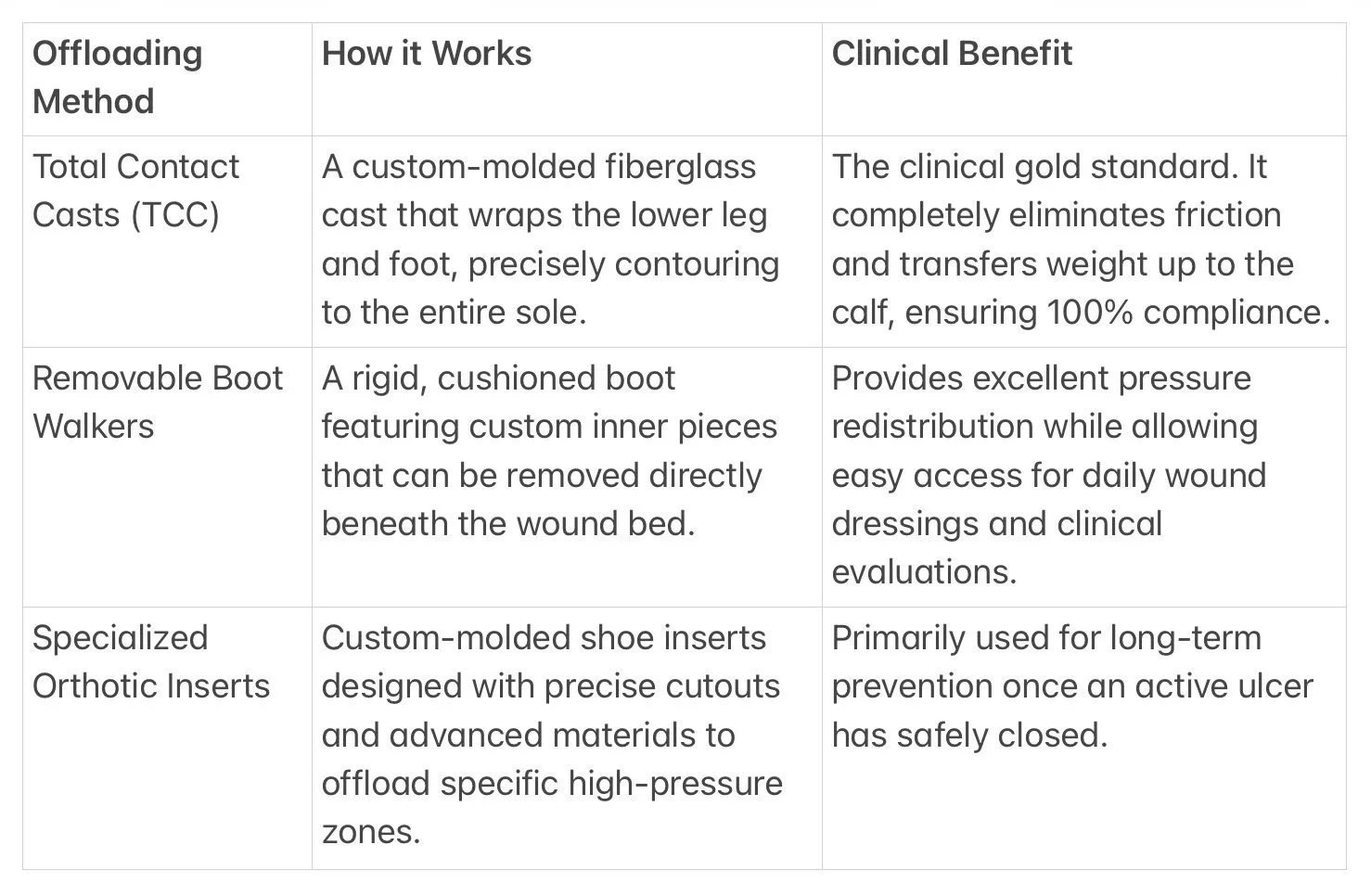
Partner With Vertex for Total Foot Protection
Healing a diabetic foot ulcer requires a meticulous, multi-front approach. Applying the world's best topical treatments won't yield results if the wound is repeatedly crushed by your body weight every time you take a step.
At Vertex Wound Specialists, our team is dedicated to preserving your long-term mobility and preventing serious complications. We provide comprehensive vascular assessments, advanced bioburden management, and custom-tailored offloading solutions designed around your unique lifestyle and healing needs.
Your feet carry you through life, let us help carry the burden. If you notice a break in the skin, redness, or an ulcer on your foot, do not wait for pain to tell you it's serious. Contact Vertex Wound Specialists today to schedule an expert clinical consultation.

References
Armstrong, D. G., Boulton, A. J. M., & Bus, S. A. (2017). Diabetic foot ulcers and their recurrence. New England Journal of Medicine, 376(24), 2367-2375. https://doi.org/10.1056/NEJMra1615439
Bus, S. A., Armstrong, D. G., & Schaper, N. C. (2020). Guidelines on offloading foot ulcers in persons with diabetes: IWGDF 2019 update. Diabetes/Metabolism Research and Reviews, 36(S1), e3274. https://doi.org/10.1002/dmrr.3274
